
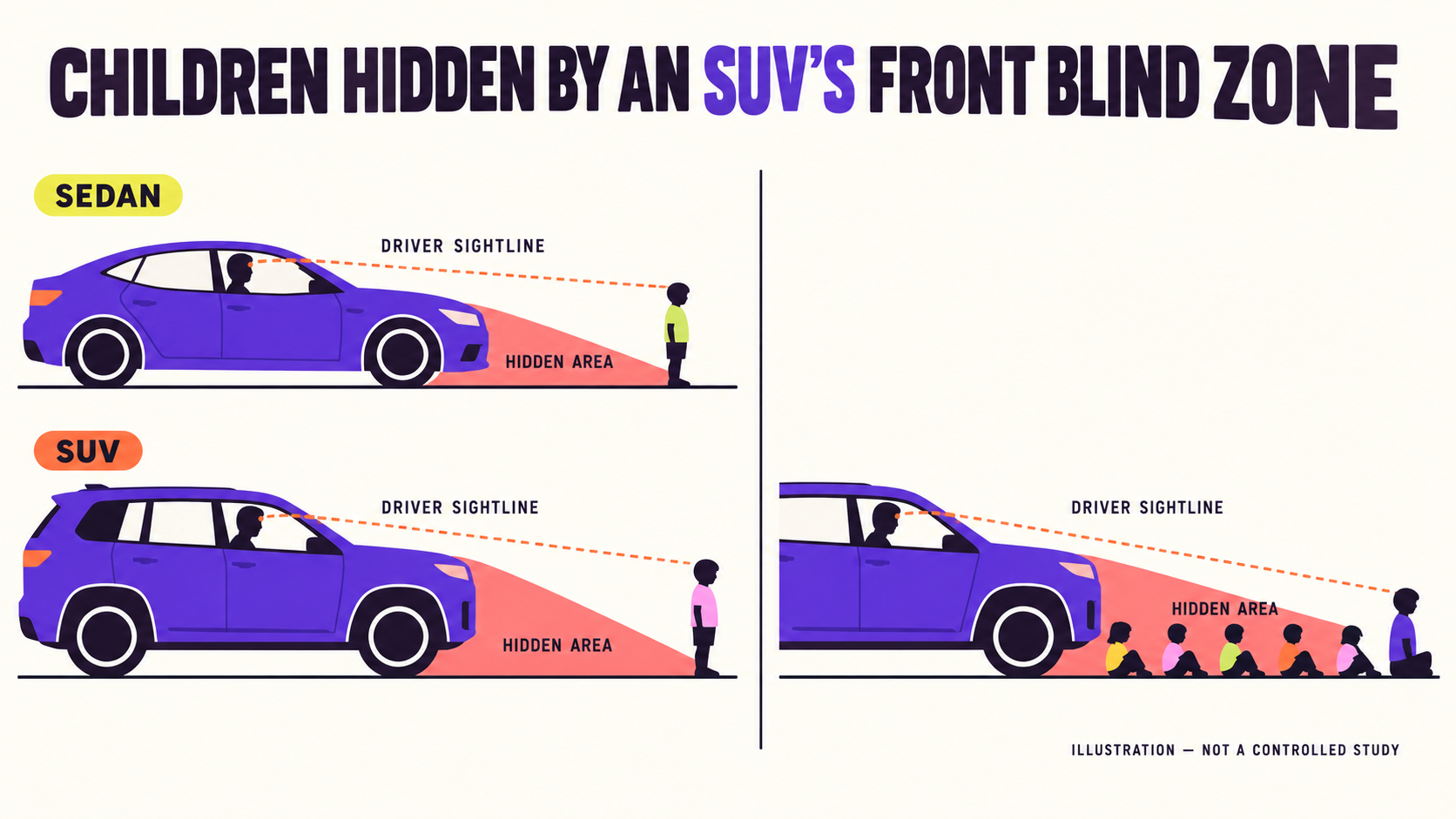
A driver sits behind the wheel of a modern SUV. Directly in front of the vehicle, children are seated in a line.
From outside, the scene looks absurd. The children are not far away. They are not darting into traffic or emerging from behind a parked car. They are directly in front of the SUV. Yet its hood rises so high—and extends so far ahead of the driver—that several of them disappear from view.
Versions of this demonstration have appeared on local television stations and in safety campaigns. In some, roughly a dozen seated children fit inside the vehicle’s front blind zone before the driver can see the next child in line. The exact number is not a scientific constant. It changes with the vehicle, the driver’s height, the seat position and the way the children are arranged. But the demonstrations make a real design problem visible: A person can be directly in the path of a large vehicle and still be hidden from its driver.
At first, the lesson seems obvious. The driver needs help. The vehicle needs cameras, sensors and automatic emergency braking—perhaps, eventually, a computer capable of driving without human sight or judgment.
But there is another question, one that reaches further back in the chain of cause and effect:
Why did we build a family vehicle that requires an electronic vision system to reveal a child standing directly in front of it?
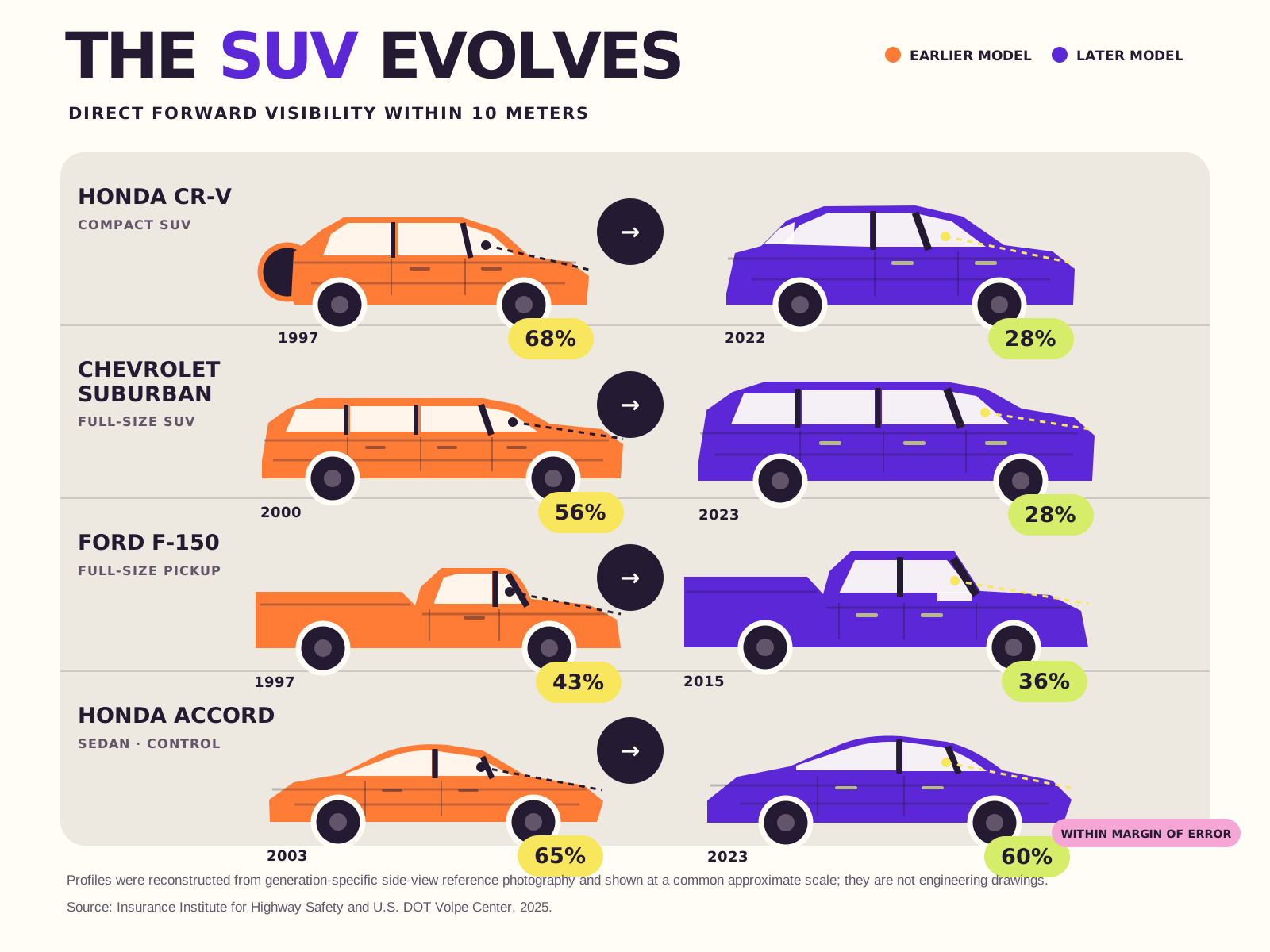
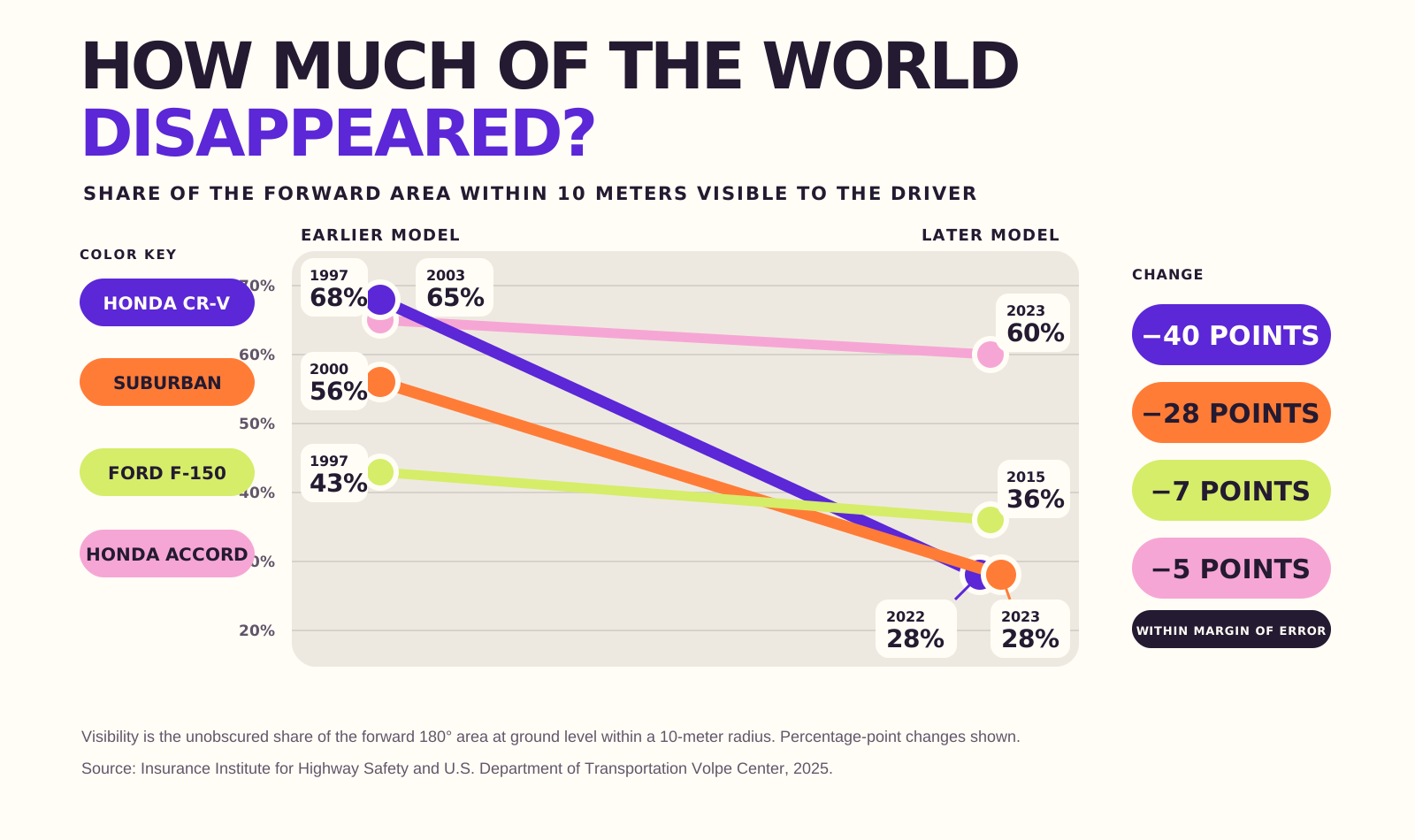
Instrumented research suggests that the problem has become substantially worse. Using a new technique to measure the area visible to a driver, researchers from the Insurance Institute for Highway Safety and the U.S. Department of Transportation’s Volpe Center compared six popular vehicles across model years from 1997 to 2023. All six lost some close-range visibility. Among the SUVs studied, the visible area immediately around the vehicle declined by as much as 58 percent.
The findings point to something larger than a flaw in a few models. Over several decades, the United States allowed its vehicles to become taller, heavier and harder to see around. At the same time, it continued building communities around fast roads and compulsory driving. Now, faced with the injuries and deaths produced by that system, America is investing tens of billions of dollars in machines that promise to operate it more safely than people can.
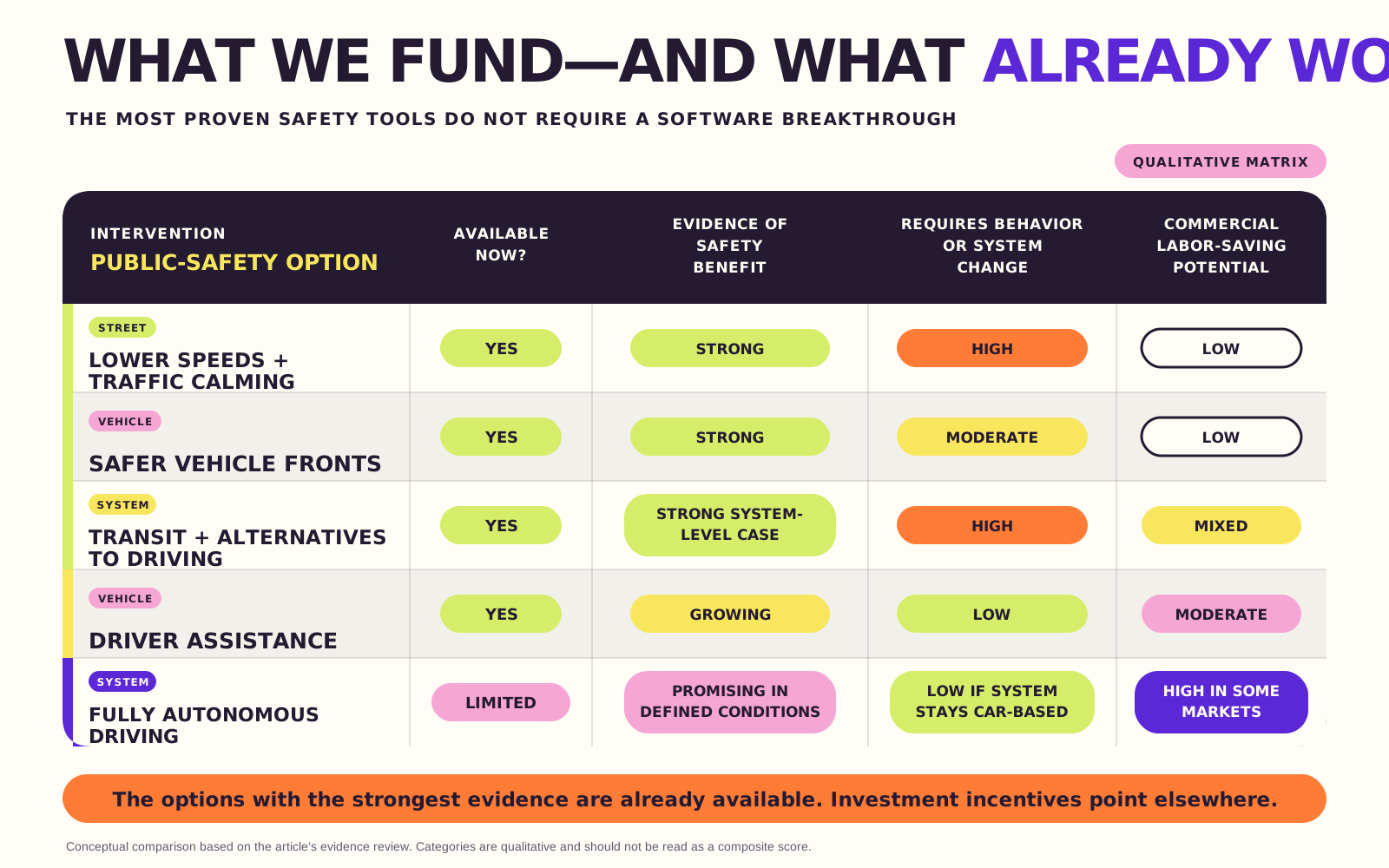
Autonomous vehicles may eventually prevent real crashes. Early evidence from some controlled deployments is encouraging. But America does not have to wait for computers to master its roads before making those roads less deadly.
Other wealthy countries have already shown that human beings can drive without killing people at anything close to the American rate. They did it with lower speeds, safer streets, less aggressive vehicle design and useful alternatives to driving.
Autonomous driving is commonly presented as an answer to human fallibility. It might be more revealing to see it as an answer to a historical choice: America made ordinary driving more dangerous than it needed to be, then began searching for an extraordinary driver capable of surviving the result.
America once made its vehicles smaller
The American vehicle did not travel in a straight line from the land yacht to the three-row SUV.
In 1975, the average new vehicle sold in the United States weighed about 4,060 pounds. The oil shocks of the 1970s, rising fuel prices and new federal efficiency requirements transformed the market. Automakers downsized their products. By 1980, average new-vehicle weight had fallen to approximately 3,228 pounds—a decline of more than 800 pounds in five years.
For a time, the American fleet was becoming smaller and lighter.
That reversal matters because it complicates one of the stories Americans tell about large vehicles: that their rise was inevitable, the natural result of prosperity, geography or consumer taste. Policy and market conditions had already moved vehicle design decisively in the opposite direction. They would soon help move it back.
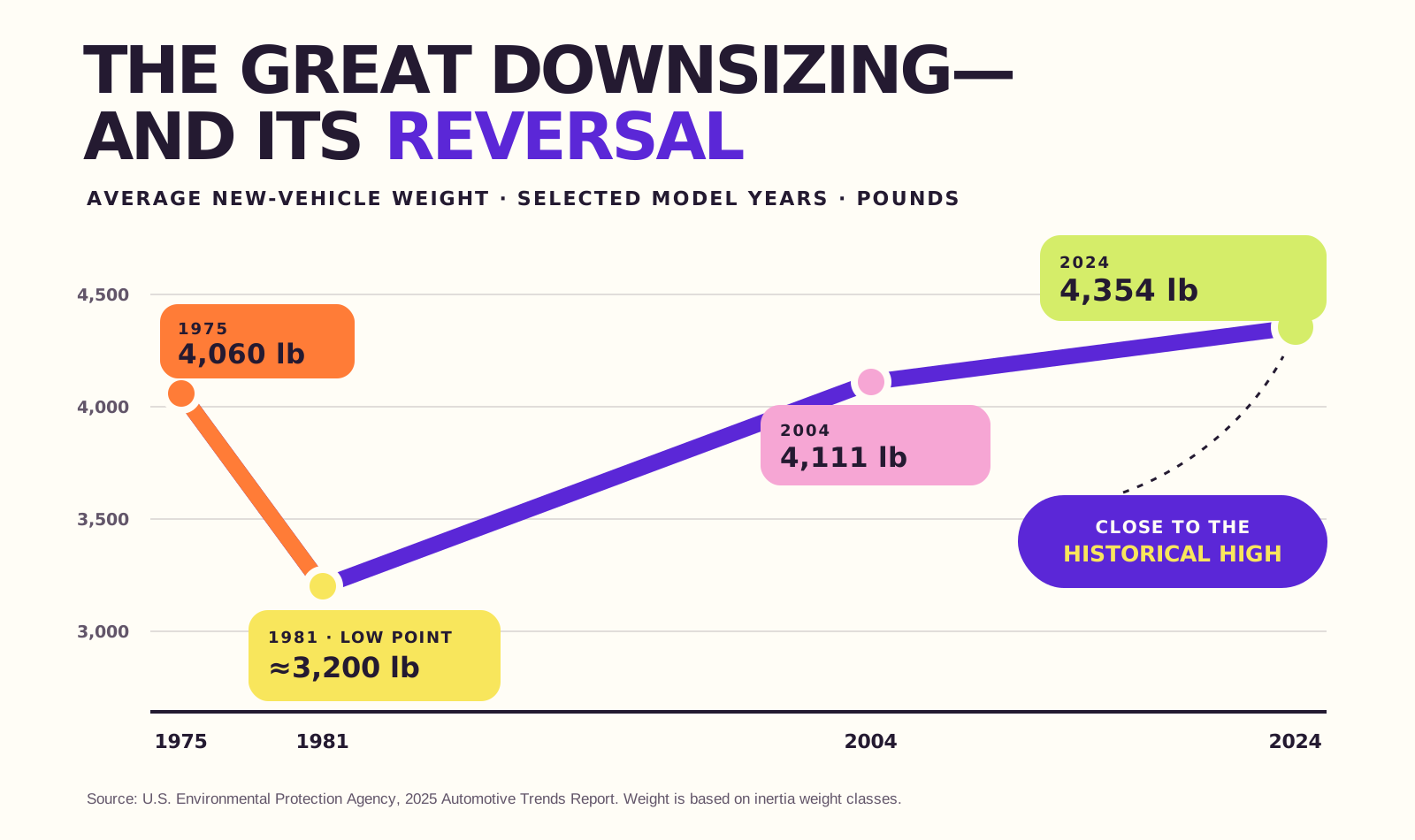
By 2004, the average had risen to 4,111 pounds, surpassing its 1975 level. In 2024, it reached 4,354 pounds.
The recovery of vehicle weight was not simply a story of sedans growing heavier. The American family car was gradually replaced by another kind of machine.
Federal rules had long distinguished passenger cars from “light trucks,” a category associated with pickups and other working vehicles. Light trucks received different fuel-economy and emissions targets. Sport utility vehicles increasingly qualified for that category, even as they moved from specialized products to mainstream family transportation. Later rules based partly on a vehicle’s footprint—the area between its wheels—generally assigned less demanding targets to larger vehicles.
Regulation did not single-handedly create the SUV. Automakers promoted them heavily. Buyers liked their cargo space, elevated seating position and image of safety and capability. Cheap fuel made their operating costs easier to ignore. Car-dependent land-use patterns made vehicle ownership essential, while wide roads and large parking spaces made bulk relatively easy to accommodate. Manufacturers also discovered that SUVs and pickups could generate attractive margins.
But regulation shaped the terrain on which those preferences operated. American rules made it easier and more profitable to sell larger vehicles. What had been partly a category for working machines became a pathway for transforming the mass-market family car.
The family car becomes a truck
For much of the 20th century, a family that needed more space might have bought a station wagon. Later, it might have chosen a minivan. Both were recognizably derived from the passenger car: relatively low, designed around moving people and built without the visual aggression of a work truck.
The SUV offered a different promise. It was taller and more commanding. It borrowed cues from off-road vehicles and pickups even when it would spend nearly all of its life on pavement. It suggested that the suburban school run required some of the machinery of an expedition.
Automakers marketed that promise extraordinarily well. SUVs became symbols of safety, status and preparedness—vehicles for people who wanted to feel ready for snowstorms, road trips, construction projects and wilderness, even if their most frequent destination was a grocery-store parking lot.
For the person inside, the appeal was understandable. A larger, heavier vehicle can provide an advantage in certain crashes, particularly when it collides with something smaller. Its elevated seating position may give the driver a sense of visibility and control. But safety for a vehicle’s occupants is not the same thing as safety for a transportation system.
A heavy SUV can protect the people inside while transferring more force to the occupants of a smaller car. A tall front end can reduce the driver’s ability to see a pedestrian while increasing the damage if the vehicle strikes one. What feels like protection at the individual level can become danger at the collective level.
As more large vehicles entered the fleet, the logic became self-reinforcing. A driver in a sedan found herself surrounded by tall grilles, blocked sightlines and thousands of pounds of additional mass. Buying a larger vehicle began to feel less like indulgence than self-defense.
Millions of individually rational decisions produced a vehicle-size arms race.
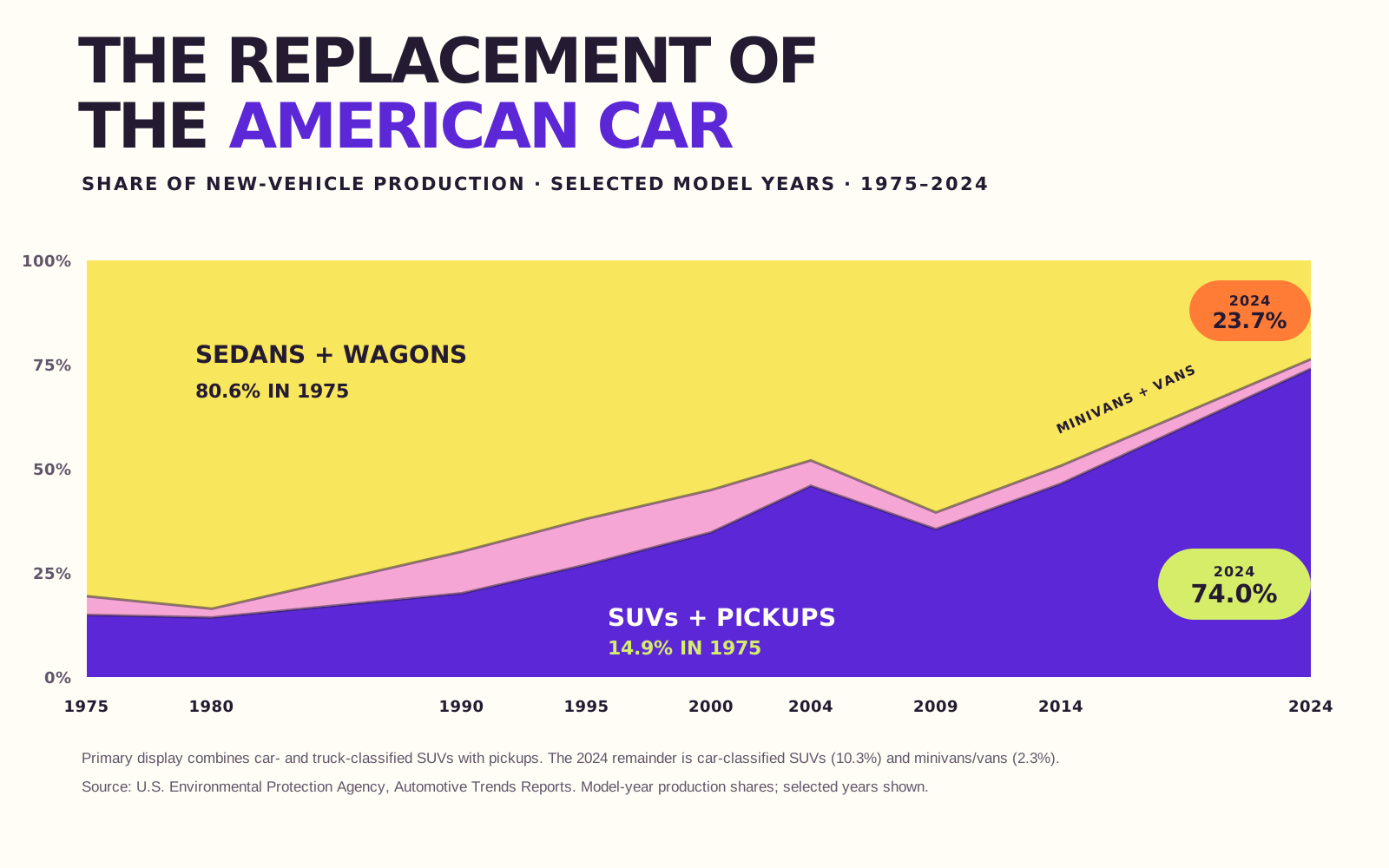
By 2024, trucks represented 66 percent of new U.S. vehicles. Truck-classified SUVs alone accounted for about half of production. Sedans and wagons, which had represented nearly half the market only a decade earlier, fell below one-quarter.
The conventional American car did not merely get larger. It was replaced by a different vehicle form.
The rise of the wall-like front end
Weight tells only part of the story.
A vehicle can become more dangerous to people outside it without gaining a single pound. Raise its hood. Flatten its grille. Thicken its roof pillars. Enlarge its mirrors. Lift its beltline. Move the driver farther from the area directly in front of the bumper. Each change can affect what the driver sees, where a pedestrian is struck and what happens to the body after impact.
Together, these changes have produced the characteristic face of the modern pickup and many SUVs: tall, broad and increasingly vertical. Where an older passenger car presented a low, sloped surface, a contemporary truck may present something closer to a moving wall.
This distinction matters because “big” is too imprecise. The safety consequences of vehicle growth arise from several interacting qualities: mass, height, geometry and visibility.
The IIHS and Volpe Center comparisons make that transformation measurable. In a 1997 Honda CR-V, researchers estimated that the driver could see 68 percent of the area within 10 meters of the vehicle’s front edge. In a 2022 CR-V, that figure was 28 percent.
A 2000 Chevrolet Suburban offered visibility over 56 percent of the nearby forward area. By 2023, the figure was also 28 percent.
The Ford F-150 began from a poor baseline: 43 percent in 1997. By 2015, it had fallen to 36 percent.
The deterioration was not equivalent across every model. In the Honda Accord comparison, the measured change was much smaller and within the study’s margin of error. That contrast is useful. It suggests that the loss of visibility is not simply an unavoidable feature of newer vehicles. Vehicle form matters.
Percentages describe the trend, but they do not convey the human experience of the space that has disappeared.
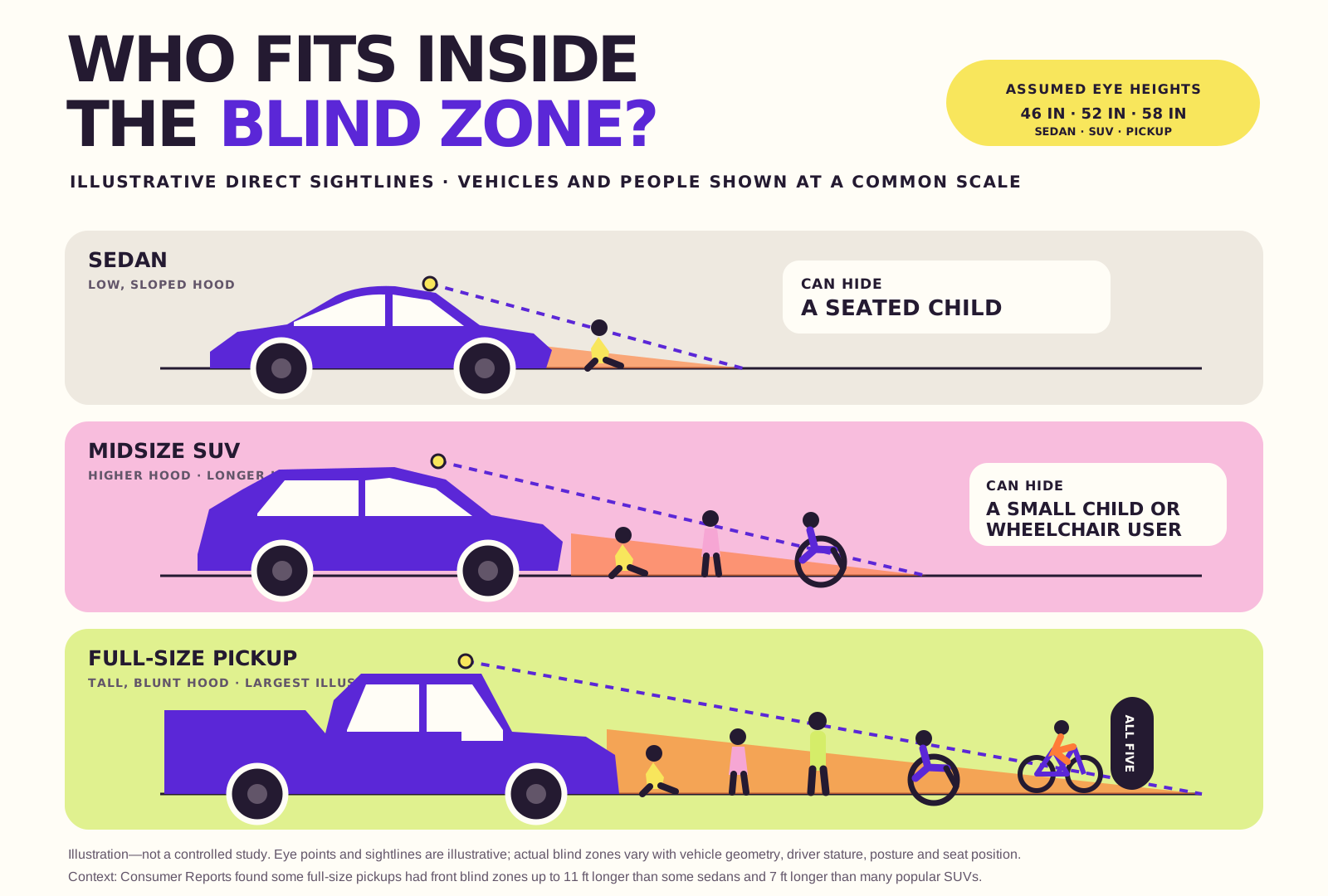
A front blind zone can contain a seated child, a standing preschooler, a wheelchair user or, depending on the vehicle and driver, an adult. Consumer Reports found that full-size pickups could have front blind zones 11 feet longer than those of cars and seven feet longer than those of SUVs.
Driver stature also matters. A shorter driver’s eyes sit lower relative to the hood, generally enlarging the hidden area. Seat adjustment, posture and vehicle design create additional variation. Not every SUV has worse visibility than every sedan. But the broad trend is difficult to mistake: Some of the most popular vehicles on American roads make the space immediately around them harder for a person to see.
The design choices become bodily harm
The first danger is that the driver fails to see the person.
This is particularly important in the places where drivers may assume low speed means low risk: driveways, parking lots, school pickup areas and intersections. A child crosses directly in front of a vehicle. A person using a wheelchair moves through a parking aisle. A cyclist waits beside a thick windshield pillar. The vehicle begins to move before the driver realizes that the space is occupied.
Front cameras can help. So can parking sensors and automatic emergency braking. But each is a technological compensation for a physical design problem. The camera does not lower the hood. It creates a second, mediated field of vision because the direct one has been obstructed.
Then comes the impact itself.
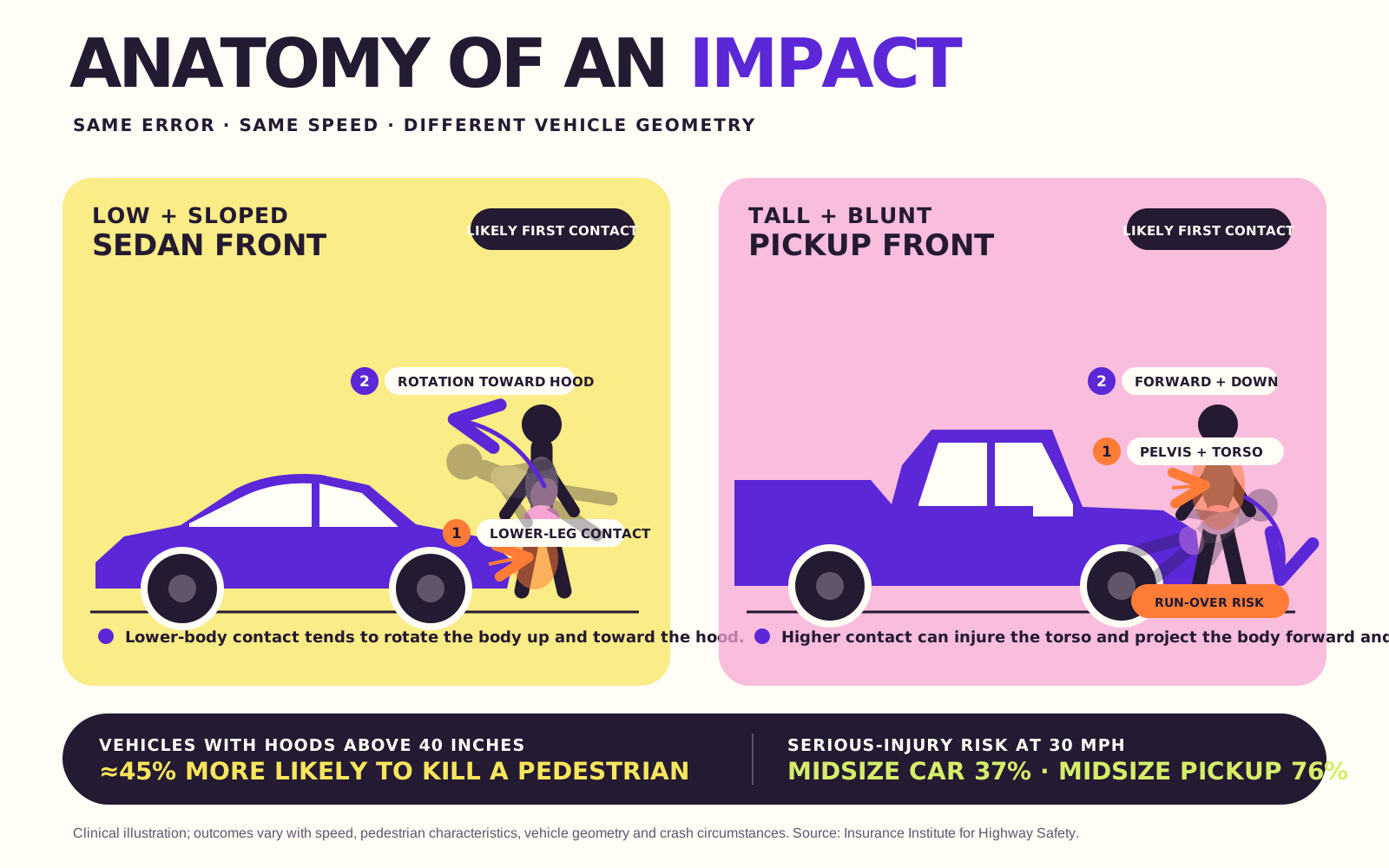
A low, sloped car tends to strike an adult pedestrian in the legs. The person may roll onto the hood, an event that can still be catastrophic but distributes force differently and may carry the body away from the wheels.
A tall, blunt vehicle is more likely to strike the torso, where vital organs are concentrated. It can throw the person forward and down rather than up and over, increasing the risk that the vehicle will run over the body.
IIHS found that vehicles with hoods higher than 40 inches were about 45 percent more likely to kill pedestrians than vehicles with low, sloped fronts. At 30 miles per hour, the institute estimates a 37 percent risk of serious injury in a collision with a midsize car. For a midsize pickup, it estimates 76 percent.
The driver can make the same mistake at the same speed. The vehicle’s design can determine whether the person outside survives it.
For decades, American vehicle safety has concentrated heavily on the question of crash survival inside the cabin. Seat belts, airbags, crumple zones and stronger occupant compartments have saved lives. That progress is real.
But it is incomplete. A transportation system must also account for the danger a product imposes on people who did not buy it: pedestrians, cyclists, wheelchair users, children in driveways and occupants of smaller vehicles.
We rewarded vehicles that made their owners feel safer by making safety more difficult for everyone else.
That is the hole America created.
Other countries took a different path
The United States is not the only wealthy country whose residents drive cars. It is not the only one with distracted drivers, aging drivers, impatient drivers or drivers who make mistakes.
Yet its roads are markedly more deadly.
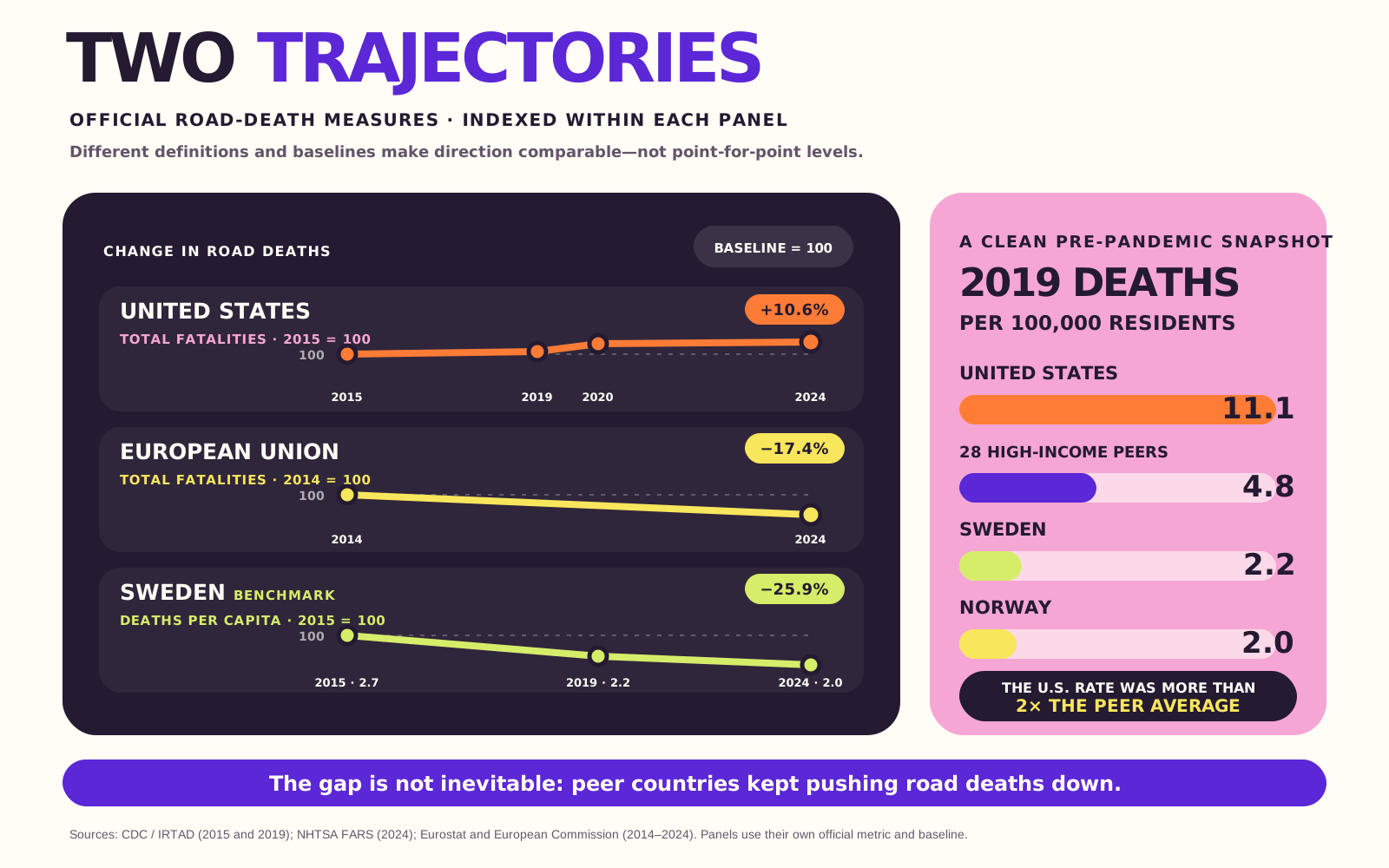
In 2019, before the pandemic distorted travel patterns, the United States recorded 11.1 road deaths per 100,000 residents. The average across 28 other high-income countries was 4.8. Sweden recorded 2.2; Norway, 2.0.
Those countries did not eliminate human error. They built systems less likely to convert an error into a death.
The details vary, and Europe should not be romanticized as a single perfected model. European consumers are also buying more SUVs. Progress in reducing deaths has slowed in recent years. Dangerous roads and political resistance exist there, too.
But many peer countries have moved further toward a “safe system” approach. They lower speeds where people and vehicles mix. They calm residential streets through physical design. They provide safer crossings, narrower lanes and more protected space for walking and cycling. They maintain transit networks that allow more trips to occur without a car. Their vehicle fleets have generally been smaller, and their safety frameworks have given greater weight to pedestrians and cyclists.
The results are visible over time. European Union road deaths fell 17.4 percent between 2014 and 2024. In London, a study of 20-mile-per-hour zones—which included physical measures intended to slow drivers, not merely lower numbers on signs—found a 41.9 percent reduction in casualties.
None of these measures requires eliminating the human driver. They begin from a different premise: People will make mistakes, so vehicles and streets should be designed to make those mistakes survivable.
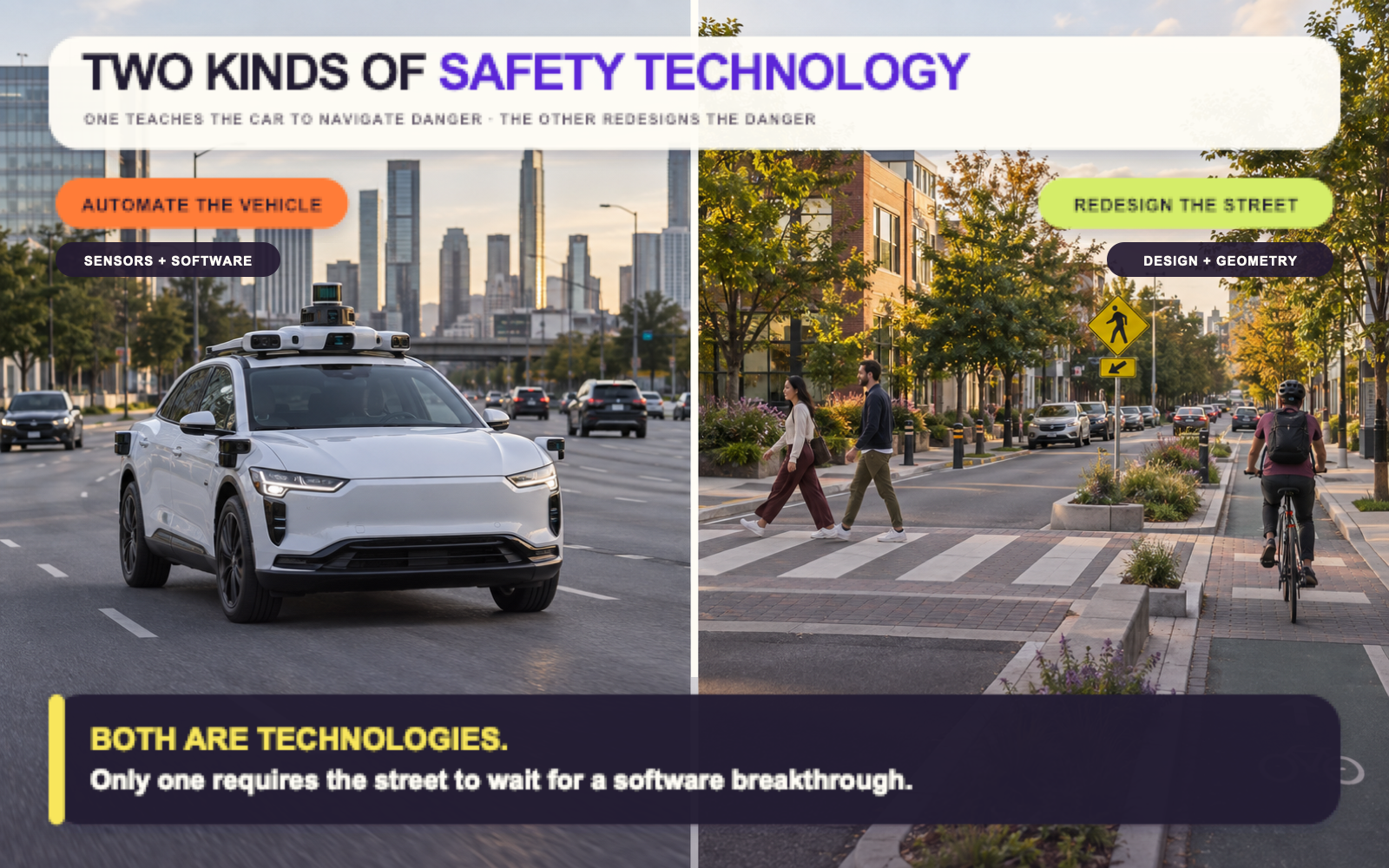
America tries to automate its way out
Autonomous driving enters this history not at the beginning but near the end—after the vehicles have grown heavier, after their hoods have risen and after communities have been reshaped around roads on which nearly every trip requires a car.
The industry is attempting to build a machine capable of compensating for human distraction, excessive speed, large blind zones, complex multilane roads, hostile intersections and a transportation system that exposes people to driving on an enormous scale.
That is an extraordinary technical undertaking. It is also a revealingly indirect response.
Rather than redesigning vehicles and streets so that an ordinary person can operate safely, America is spending tens of billions of dollars trying to design a computer capable of mastering the danger.
The safety case for autonomy is not imaginary. Human drivers become tired, drunk, distracted and angry. They misjudge speed. They look but fail to see. A well-designed automated system does not text, glance into the back seat or drive home after drinking.
Companies including Waymo and Zoox explicitly present autonomous driving as a safety intervention. That claim deserves serious evaluation rather than reflexive dismissal. One study covering 56.7 million driverless Waymo miles found substantially lower injury and serious-injury crash rates than geographically aligned human-driving benchmarks.
But three different questions are often collapsed into one:
Can a particular autonomous system operate more safely than a human driver within a defined environment?
Is autonomous driving the best or fastest public strategy for reducing road deaths?
And does making an SUV or robotaxi autonomous address the land use, speed, vehicle design and compulsory driving that made the system dangerous?
Evidence for the first proposition does not establish the second or third.
An autonomous vehicle can detect a pedestrian hidden below its hood through cameras or lidar. It can be programmed to obey a speed limit. It may react more quickly than a person. All of that could prevent a crash.
But if the vehicle remains tall, heavy and blunt, the consequences of a failure remain. If it makes empty repositioning trips, it can add mileage to crowded roads. If it draws passengers away from transit, it can increase the number of vehicles required to move the same number of people. If the community remains too dispersed to navigate without a car, automation changes who—or what—drives without changing the structure that makes driving compulsory.
The scale of the investment reflects both the difficulty of the challenge and the size of the anticipated prize. The OECD identified $95 billion in venture-capital investment between 2012 and 2020 for driverless vehicles and related mobility technologies. Broader estimates often include driver-assistance systems, chips and other adjacent technologies, so the figures should not be casually added together. The defensible conclusion is simpler: Tens of billions of dollars have been invested in autonomous driving.
Capital is not distributed according to public-safety value alone. It flows toward products capable of producing returns.
What is being automated?
The commercial attraction of autonomous driving is clearest in businesses where driving labor represents a large share of operating cost.
A robotaxi replaces a taxi or ride-hailing driver. An autonomous truck can reduce the need for a paid driver to spend days moving a load across the country. Delivery fleets can operate with fewer people assigned to one vehicle at a time. Aurora’s investor materials, for example, explicitly compare the pricing of autonomous service with driver wages and benefits and project reductions in customers’ driver costs.
No speculation about secret corporate motives is necessary. In robotaxis and autonomous trucking, eliminating or reducing paid driving labor is not incidental to the business model. It is one of its central economic advantages.
This helps explain why the comparison with public transportation is so important.
The private car is typically a machine in which one person drives one or a few people. In a taxi, another person must be paid to perform that task. Remove the driver and a large amount of labor can be eliminated from each passenger trip. The car, however, continues to occupy road space. It continues to require pavement, signals, pickup zones and storage. Unless trips are efficiently shared, it continues to move a small number of passengers at a time.
Transit has already captured much of the fundamental labor-productivity gain.
One bus operator can transport dozens of people simultaneously. A train operator can oversee a vehicle carrying hundreds and can move many more over the course of a shift. The labor cost is distributed across far more passenger trips.
The bus has already solved much of the labor-productivity problem that the robotaxi is designed to solve. One person is already driving many people.
That does not mean transit automation lacks value. Driverless metro systems have operated for decades. Automation can allow more frequent service, longer operating hours and greater schedule flexibility. It may help agencies respond to operator shortages or shift workers into passenger assistance, supervision, maintenance and security. It can reduce some operating costs.
But the scale and nature of the gain differ. Automating a car removes one driver from a vehicle commonly carrying one or two people. Automating a high-capacity train removes one worker from a system already moving hundreds of people per vehicle.
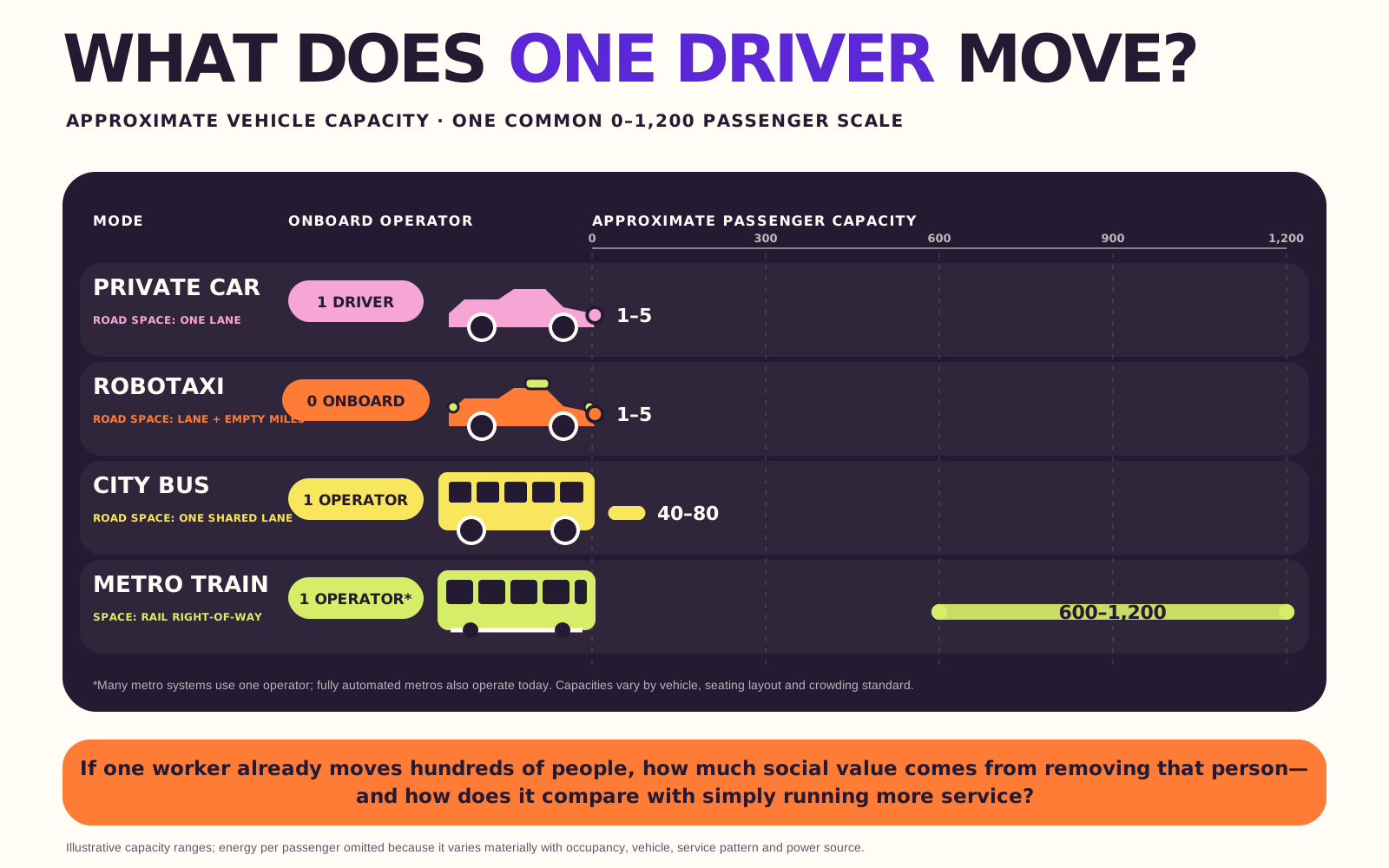
Even a perfectly driven robotaxi can preserve the geometry of car dependence: low occupancy, traffic congestion, large amounts of urban land devoted to roads and long travel distances created by sprawl. It may also produce empty repositioning trips as vehicles travel to collect their next passengers.
Under favorable conditions, shared autonomous vehicles might reduce private ownership or improve mobility for people who cannot drive. Under others, they could compete with buses and trains, add traffic and make individualized vehicle travel even more convenient relative to shared transportation. The outcome will depend not only on software but on pricing, regulation, street allocation and public investment.
Autonomous driving may solve the driver problem while leaving the transportation problem intact.
The road not taken is still available
America does not have to choose between banning autonomous vehicles and waiting passively for them to mature. It can test and regulate automated systems while acting immediately on the sources of danger already in view.
It can begin with the vehicles.
Regulators can establish meaningful standards for direct visibility. Safety ratings can account for the danger a vehicle presents to people outside it, not only the protection it offers occupants. Rules can address hood height and front-end geometry. Fuel-economy policy can stop rewarding larger footprints. Pedestrian-detection and automatic-braking systems can be strengthened while regulators insist that cameras and software not become excuses for poor physical design.
The country can also change the streets.
Where people and vehicles mix, speeds can be reduced to levels compatible with survival. Wide lanes can be narrowed. Raised crossings, curb extensions and pedestrian islands can shorten exposure and make people easier to see. Protected cycling routes can reduce the number of conflicts that drivers must interpret. Intersections can be designed for the speed at which people should travel through them, rather than posted with limits the geometry encourages drivers to ignore.
Finally, America can reduce the amount of danger people must encounter simply to live their lives.
Frequent, reliable transit is safety infrastructure. So are sidewalks, bicycle networks and communities in which homes are close enough to jobs, schools and stores that every routine errand does not require a car. A trip that can be completed safely without driving removes the possibility of a car crash from that journey altogether.
Safety should be measured not only per vehicle mile but per person moved—and, ultimately, by whether people can reach the places they need without being exposed to unnecessary risk.
Autonomous systems should face serious, transparent evaluation. Their crash results should be independently verifiable. Companies should disclose the conditions in which their systems operate and the situations in which human assistance is required. Policymakers should examine their effects on congestion, total vehicle mileage, accessibility, labor, transit use and the distribution of danger.
Autonomous vehicles may become a useful layer in a safe transportation system. They should not become an excuse for refusing to build that system.
Stop digging
Return to the SUV and the children hidden in front of it.
The driver’s inability to see them is real. A camera might reveal them. Automatic braking might stop the vehicle. A sufficiently capable autonomous system might detect each child, predict the danger and refuse to move.
Those would be genuine safety gains.
But each intervention begins after a more basic failure: America permitted the construction of a family vehicle from which a driver cannot directly see a child in its path.
We made the vehicles larger. We raised their hoods. We widened the roads and increased the speeds. We separated homes from jobs and stores until driving became compulsory. Then, faced with the deaths produced by that system, we decided the missing ingredient was a better driver.
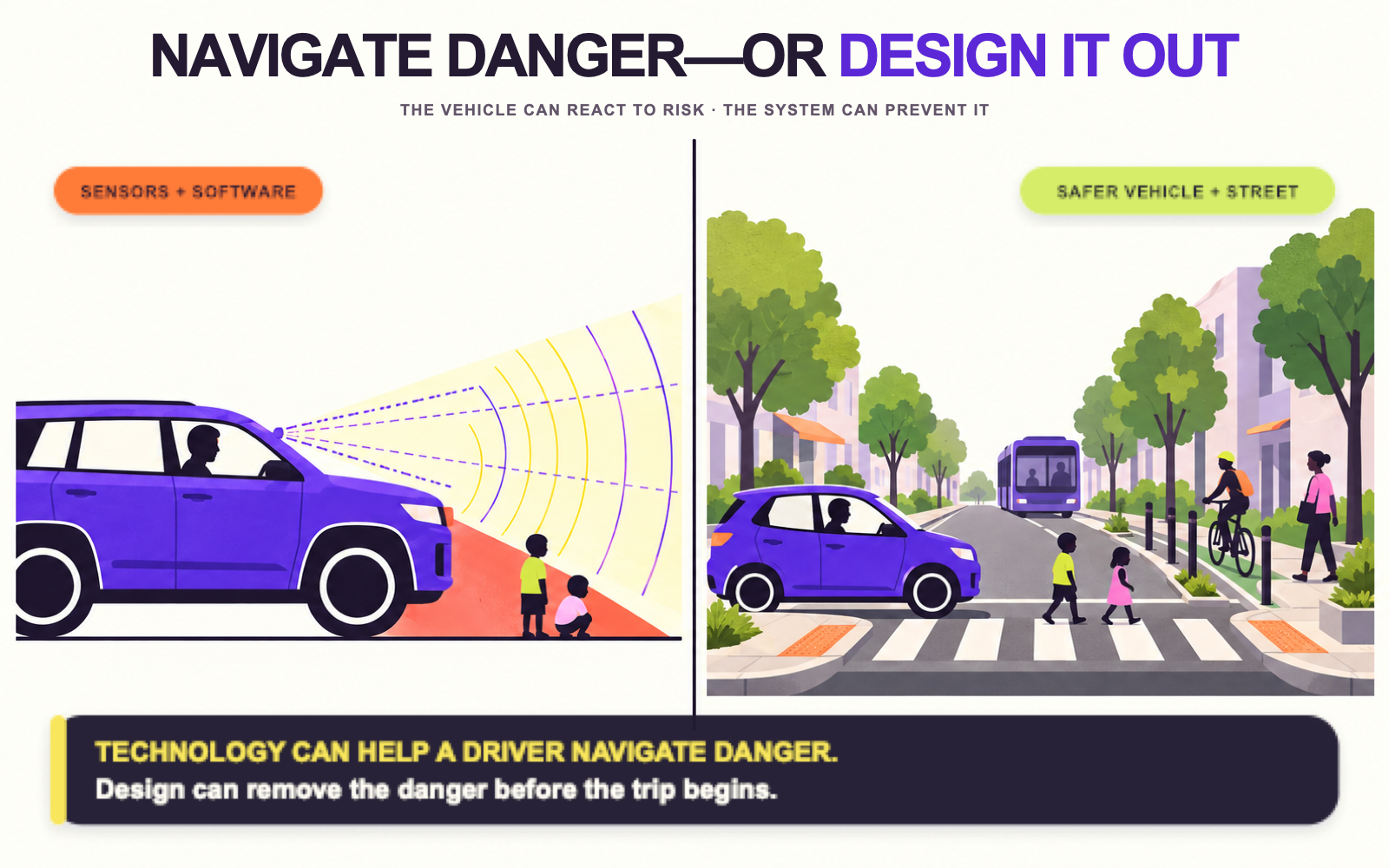
Autonomous driving may produce real safety gains. But America does not need to automate its way out of the road-safety crisis. It can stop designing danger into the vehicles, streets and daily journeys people use now.
The first step is not teaching the car to see.
It is refusing to build a world the driver cannot.